 Simran Singh: Jonathan Goldman is an international authority and pioneer in the field of sound healing, and he is the author of numerous books including the 7 Secrets of Sound Healing, and the best-selling book The Humming Effect, which he co-authored with his wife, Andi Goldman. That also won the 2018 Gold Visionary Award for Health Books. His classic Healing Sounds has just had a special 30th Anniversary Edition released and that is what we are going to celebrate today among a couple of other things in his life. But we’re going to talk a lot about that today. Jonathan is the director of the Sound Healers Association and president of Spirit Music, Inc. in Boulder, Colorado. He’s a Grammy nominee, has created over 25 Best Selling award winning recordings, including “Chakra Chants”, “The Divine Name” with Gregg Braden, “Frequencies: Sounds of Healing” and “Reiki Chants”. And he has been named as one of Watkins Mind Body Spirit magazine’s 100 Most Spiritually Influential Living People. You can find out more about him at www.healingsounds.com.
I’d love to start off, you’ve had quite a history and really are this pioneer in the field of sound healing. And you’ve had such a history of not only sharing through the written word, but through many types of workshops and CDs and music and, and all of these different things. And I think it is becoming more and more understood in the greater population, that sound really does heal, that it has this effect and this power over our body in terms of regulating us and bring us back into harmony and bringing us up towards the higher frequencies that we all desire to reach on some level. I’d love to talk a little bit about this 30th Anniversary Edition of Healing Sounds: The Power of Harmonics, and for people that are not quite familiar with this or are new to how sound can truly affect us talk a little bit about how you have found sound to be a healer in your own life, and what was the catalyst for really spending a lifetime in advocacy for humanity as well as this work?
Jonathan Goldman: Thank you, Simran. What a great, great question. And I’ll try to make this really brief. Simply put, the idea is that everything in the universe is in a state of vibration. And this vibration could be perceived of as a sound “In the beginning was the Word”, “And the Lord said, ‘Let there be Light’.”. And the vibrations include, actually our body and our etheric fields. And when we are in a state of being a tuned, we’re like this wonderful orchestra that’s playing the symphony the self. But if a part of our body begins to vibrate out of its correct resonant frequency, or frequencies, it’s a little bit like the second violin player losing their sheet music and playing the wrong notes. And we say that this part of the body is vibrating ease out of harmony, that it’s diseased. So the idea is simply of using sound to heal is to give the string player back their sheet music. That’s number one. That’s just the overall gestalt of how sound can heal. But of course, this is huge. Or to quote the New York Times science section, February 8, 1988 (so this is not new), “Sound shaped into dazzling tool–can make break or rearrange molecular structure.” So people say, Well, what can you sound heal? I say if you can rearrange molecular structure, what can’t you potentially put back in balance and heal?
Simran Singh: That’s really powerful. I love in the book, you write harmonics have been described in mystical literature as providing a stairway to heaven. And you go on to say that the universal principles display by harmonics are one of the foundational aspects that modern quantum physicists perceive are responsible for manifesting the creation of reality. And so if we can shift to molecular structure, then that means that not only can we shift what’s going on in our bodies, we can shift what’s going on, in what we call reality and create new versions of reality. Does someone have to understand how this works? Jonathan, do they have to have a certain intention? Is there a certain level of presence? can just simply listening to music? do its own thing for us? How exactly does this work? Wow, you
Jonathan Goldman: You just asked about five questions. (Laughs). Well, let me just see if I can get into one of them. Do we have to have an understanding? No, there’s an aspect of sound that is purely the experience of the sound, which unto itself is the teacher, whether it’s music, whether it’s our own voice, whether whatever it can be a crystal bowl, a tuning fork, an Om or a conversation with someone else that, you know, we experienced that in our bodies, our brains our energetic fields. And that’s the real thing. But I think what is important and why I was if you like, so pleased that Healing Sounds which was written 30 years ago would have another rebirth was the fact that there are certain elements in the book, that 30 years have now given them time to really take root in the whole consciousness of our planet. And there’s some stuff in there that’s really just been understood and utilized. And a lot of the modern sound healing movement has grown out of that. But there’s still a few things that have done “flybys” for people. And I would love to correct that such as the concept of harmonics. I would love for that awareness and understanding to begin to take hold. The things that have taken hold are among other things concept as you were mentioning, such as intentionality, which I have a formula in the book, which is “frequency plus intent equals healing”. I’ll repeat it again, because it’s so important “frequency”, which means the sound or the vibrations of the sound, “plus intent”, which is the energy or the consciousness encoded on the sound, “equals healing” which is the outcome that you desire for the sound, and I first probably came up with this in the mid-1980s. And then I first wrote about it in Healing Sounds, putting this formula forth and while Simran, the idea that we encode sound with our consciousness is really not new. There’s a sub corollary in the book, which is “vocalization plus visualization equals manifestation”. When I first came up with that one, I thought, oh boy, I’m so original and then I realized that practically every spiritual and magical tradition on the planet utilizes this as a principle. I simply had put it together and you know, made a formula of it. But this concept of frequency plus intent is so important, because as we move into the realm of understanding vibration and frequency, it’s really, really mandatory that we understand that it’s not only the actual s encodement of a sound that creates the effect–the vibration, but also what we put into the sound.
Simran Singh: You know, I love that you have these formulas, though, because I think we live in a world where we want to have those quick references that we can remember so that we are able to ground into a practice, we live in such a distracting world that I think sometimes it does take more time to sit and be present for things and to learn them. And, and sometimes it’s those quick steps that deepen us into the presence of wanting to go further into and learn more about things. I love that vocalization, visualization and manifestation. Because it really drills down like you said, what many of the ancient spiritual masters have said around this, but it creates it in such a simple way that an individual can all of a sudden say, You know what, I really do need to take time for this, I need to understand how I’m vocalizing I need to allow myself to, to utilize sound and music in a certain way. And I loved one of your other books, The Humming Effect, because it made it very accessible. And it brought us back to how we were as children, I think about my younger son and he’s always been a hummer. And so to return us to these places where we begin to realize that harmony is part of who we are. And that we have to reclaim that only empowers us to be then greater creators in other ways. Talk a little bit about starting off with the basics of sound for someone that has forgotten or gotten away from really understanding how the power of their voice or their harmony might actually initiate more access to the divine.
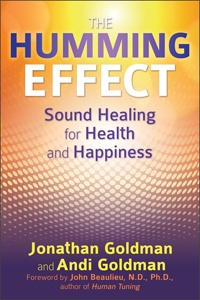 Jonathan Goldman: Well, thank you. And once again, we do have the book The Humming Effect, which continues to draw great interest and have lots of positive response from people. And that’s simply because it presents a really easy, yet powerful way that people can experience the sound. And with the hum, which is the sound that everyone can resonate with including your son, your daughter, your mother, your father–anybody can hum. Everybody hums. People hum when they feel good. And so Andi and I wrote this book, basically, because we wanted to find a sound that was all inclusive, and that everyone could make because people have gotten so jaded by so many of the different television shows, etc.. They’ve always been maybe like, judgmental about the voice. But now with things like “The Voice” or “American Idol” or whatnot, people just judge their tones and their sound so much, that it’s really become restrictive, to really make sound. And you know, the one thing that we don’t judge ourselves on is the hum, and yet the harm can be truly, truly powerful as a tone, not only changing all sorts of things in our body, in our brain, but also in our electromagnetic fields. And when people once people even hum for a brief period of time, they’re changed.
Simran Singh: And I think there is a great deal of importance that we have to place upon how we feel and in the power of sound, to shift our feeling of we live in a world that has increasing duality. It feels like it has divisiveness, it has so many things that we can react to and become volatile with that– can sound be used as this equalizer as this momentary place to go to really increase our emotional intelligence to a place where we neutralize perhaps a reactivity that we’re having in a moment?
Jonathan Goldman: Oh, most definitely. I mean, from anything as simple as just first of all, helping us chill out in a time of stress of which they seem to be occurring all the time now, and you talk about the divisiveness. Well, one of the things that creates the divisiveness is fear. And one of the great ways of overcoming fear, believe it or not, is with sound. And I’ll just mention the hum again, because the hum really seems to affect, among other things, the vagus nerve. And the vagus nerve, of course is, you know, you can either be in a state of fight or flight, or you can be in a state of homeostasis and relaxation. The vagus nerve, works with the parasympathetic system, and basically, if you hum, you can basically put the parasympathetic system in action. And that’s the system that basically causes us to relax and chill out as opposed to run. And that’s so very important. And I say, again, that even just taking a couple of deep breaths, and then doing a nice elongated hum, will lower your heart rate and respiration. You do that a few times and it’s really, really a powerful tool.
Simran Singh: Do you think that as we move more toward a practice of sound for someone that perhaps is not utilized it in their own life, for healing for empowerment for, you know, pure enjoyment? There is that space of judgment that sometimes happen, and you kind of mentioned it, because of the, you know, the social aspect of television shows in reality television and that type of thing that has created this judgment, around sound, for someone that really thinks of themselves as someone that perhaps does not have harmony or cannot keep something in tune? What is the power of both resonance and dissonance? Do you feel like they are equally important? And do they each serve?
Jonathan Goldman: What a brilliant question and I don’t know if I have a soundbite to answer that one. Because I think it depends upon the person. I like to say that any sound depending upon the time, the place and the need of the individual can be therapeutic, any sound. So but at the same time, I think for most people in our world because they are so plagued by the havoc of fear, and divisiveness, that perhaps dissonant sounds are not necessarily serving us as much as they can. I guess when you’re at a really excellent state of being a mystic on a mountaintop, you can be you can have planes zooming over you and you know, sirens going by and leaf blowers going by and these beings can just sit there and totally disregarded these sounds. But for a lot of people, until they reach that level of consciousness, such sounds can cause some distractions, you know, and therefore, with your answer, I would like to suggest that for most people, we need to try to get ourselves into a state of homeostasis– into a state of balance. And oftentimes, it’s the more relaxing sounds that help induce this.
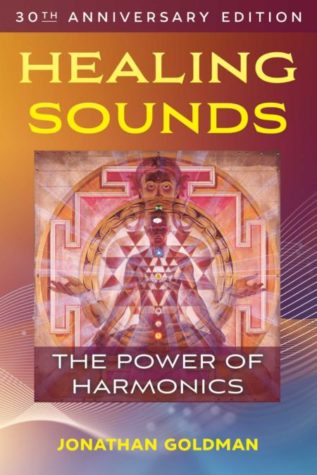 Simran Singh: In the 30th anniversary edition of Healing Sounds: The Power of Harmonics, Jonathan Goldman says “it is important to understand that in alignment with this concept of sound, every organ, bone and tissue in your body has its own separate resonant frequency. Together, they make up a composite frequency, a harmonic that is your own personal vibratory rate. Through resonance, it is possible for the vibrations of one vibrating body to reach out and set another body into motion”.
I want to go back to what I just read from your book. And it had to do with the alignment of sound within every organ, bone and tissue of our body. And I think that sometimes we don’t realize that we really are a musical instrument, like every part of our body has this capacity. And we often think of sound as something that we listened to. And sometimes that we make, but not necessarily how it courses through us– how the rhythms and the vibrations, and all of that kind of happens on its own, even when we’re not listening. Or when we’re not consciously creating the sound, talk a little bit more about this body that we have, and how we truly can lift it up into being this vibratory instrument.
Jonathan Goldman: I’m going to actually talk about first, the two different ways that sound affects us. The first is called “psychoacoustics”. And this is where a sound goes into our ear, into our brain and affects our nervous system, our heart rate or respiration, our brainwaves. And usually, this occurs through listening t either musically, or vocally or whatnot. That’s psychoacoustics. And the other is called “vibroacoustics”. And this is where the sound actually goes into our cells, goes into our molecules and DNA. And so there’s a resonance of our physical body. And both of these are ways that sound can affect us. And I will say that currently of science is really looking at simply the psychoacoustic aspects of putting people in the MRIs and whatnot to see how the brainwaves are being affected by sound. But I’m going to suggest that a lot of the real aspect of the healing and frequency shifting nature of sound is also based upon what is the sound doing when it goes into your body? The vibroacoustic aspects. And there are certain techniques or certain tools where sound goes into the body, and it literally rearranges molecular structure, and can cause that which is vibrating out of ease or out of harmony, to become imbalanced. And that’s so incredibly important to understand and consider.
Simran Singh: When we think about the balances and the imbalances, I love something that you shared from a dear colleague of yours, Dr. Steven Halpern, who said that sound is a carrier wave of consciousness. And in the book Healing Sounds, you went on to say that if you’re angry and you create a sound, even though it may be a pleasant sound, you’ll be sending anger that is incorporated in with that sound. That’s a very powerful thing for us to discern, especially now more than ever, that when we are in any type of interaction, or when we are perceiving something on television or something that’s going on in the world, that goes back to that intent of sound that you were speaking of earlier. Talk a little bit more about that.
Jonathan Goldman: That is so very important. And basically, if I can just suggest to people that we can begin to use the healing power of sound simply when we’re in a conversation. You can, if you like encode your words with kindness, compassion, and all sorts of positive aspects and other people will perceive it. If you are kind of angry and negative, they’re going to pick that up as well. I go for a walk with my wife every day, around a sort of park area. And when I see people, I just always go, “Hello, how you doing?” And I consciously project positive energy from myself, I’m beaming them with light and love–they don’t know it. But I can feel some of them be affected–all of a sudden their bodily structures changes—they straighten up, they may have been looking at the ground with their head down, and they’ll smile and go, “Okay, thanks. How are you?” So we can simply working with our conversational voice. We can project healing sounds, that’s number one. And I mean, conversely you know, perhaps you’ve been at a party, and you meet somebody that had real issues with you. And they looked at you and go, “lovely to see you”. And you feel like you’ve been psychically slimed. The words may have said, “lovely to see you”, but the energy that was encoded on it was negative. We’ve all had that happen, you know. If we can, if you’d like to apply that principle also, even to watching announcers and broadcasters and people on TV, how are the words making you feel?
Simran Singh: It’s so important, it’s the little things that we can do. And I’ve always said, you know, when one person really can change the world, and it is, in the small steps, the little things that we choose to intentionally partake in and within our lives, and so simple, through our words, through our actions, to our energies to our intent, as you said, our vocalization of visualization, that is how we create the world that is outside in front of us. And I think now more than ever, kindness is the key and tone of voice intent energy are the stepping stones to that, for individuals that are wanting to really utilize sound to, to take not only the world to a different place, but really elevate themselves in terms of their own frequency and vibration in a concentrated way. I know that you have some work around, excuse me, the Divine Names. And so when it comes to sound when we not only incorporate sound, but then we incorporate specific types of words, or names that have their own vibrational power. Talk about how that shifts, the inner and the outer
Jonathan Goldman: I’m going to right now jump right immediately into the concept of harmonics. Because as soon as we talk about the Divine Name or anything like that, we need to bring in the concept of harmonics, which is really a long overdue aspect of our understanding of sound. You know, as I mentioned, we understand on a level how frequency can affect us. But really, harmonics are a key to sound that most people, they use the word but they don’t understand it. And on a level, just saying that first of all, I’d like to say that harmonics are the mystical aspect of sound. You mentioned before that they were, if you like a stairway to heaven, indeed they are. Because there’s something called the harmonic series, that is a sequence of whole number ratios that makes up if you like, the building blocks of not only matter, but the building blocks of sound, Harmonics are responsible for the timbre or tone color of sound. So different harmonics will create different sounds. Harmonics, for example, are the reason different instruments sound the way that they do. They took the harmonics out of a violin and oboe and a piano in a laboratory, and you couldn’t tell them apart. But normally you can because the harmonics– these, if you like, colors of sound, that are that make up every sound– are responsible for not only different sounds of instruments, but literally the sound of our voice as well. Each of our voices is unique and different. Each of our voices has a Voiceprint that is as unique as you know, fingerprint or thumbprint and this is based upon the harmonics. So, if I can just continue a little further when we begin to understand harmonic and the concept of harmonics and we begin to hear them–literally the way that we process reality shifts and changes because we have enhanced one of our five major senses–the sense of sound, and the way that we either create sound or hear and listen to the sound. So, once again, the understanding of harmonics is huge. It’s huge.
Simran Singh: Within your book Healing Sounds: The Power of Harmonics, you talk about Pythagoras, and how “he believed that the universe was an immense monochord, an instrument with a single string that stretched between the heavens and the earth. The upper end of the string was attached to absolute spirit, while the lower end was connected to absolute matter. Through the study of music as an exact science, one could become familiar with all aspects of nature. And he applied his law of harmonic intervals to all of the phenomena of nature, demonstrating the harmonic relationship within the elements, the planets and the constellations. Pythagoras spoke of the music of the spheres.”
I would love to go back into a little bit more on the harmonics, especially with what we talked about in regard to Pythagoras. You also write that the science of harmonics has revealed a phenomenon of sound that has application in the fields of mathematics, physics and other natural sciences, and that the universe is harmonically related. And this relationship is found within the sounds of our voices. That our voice may be the key to understanding sound as a tool for transformation, and healing. Tell us a little bit more about harmonics so that we really start to dig into what this means and how we can experience it.
Jonathan Goldman: It’s so interesting. I think the first major thing about harmonics is simply this: when people begin to get into sound, they begin to think in terms of frequency, everything has a frequency. But in reality, there is no such thing in real life and nature as a single tone frequency. Really everything is composed of these complex, mathematically related sounds that we call harmonics and just that unto itself is quite mind altering to consider. It’s like Simran, if you look at the sunlight, and you then put it into a prism, and you see it break it into the different bandwidths of the electromagnetic spectrum that we call color. Well, harmonics, are the color of sound, and being able to hear them, being able to perhaps even begin to become consciously aware of them as we make or receive sound is totally, once again, life changing, because it literally shifts and changes the way that we perceive reality. And as an example, the different vowel sounds that we make; because of the harmonics within each of the vowel sounds, you can make the vowels on the same pitch, and yet, they will resonate in different chakras because there are different harmonics, more powerful harmonics called “formants”, in the each of the different vowel sounds that will cause a different resonance in our body. And this is extraordinary.
Simran Singh: Yes, Edgar Cayce, the sleeping prophet, said that once in a trance. You share in the book that he stated that the seven vowel sounds activate the energy centers of the body and he actually predicted that sound would be the medicine of the future and it does seem that we are in that space. Now you go on in the book to talk about how these different vowel sounds also correlate to the elements: the element of air and earth and water. And we are nature. In and of itself, we don’t always think of ourselves that way, but we too are nature, so it makes sense that we’d have to utilize the sounds to continuously balance our own elements and to tap into these activations that occur within the energy centers of the body.
Jonathan Goldman: Well, that’s all really true. And I want to say that harmonics can be very, very heady and heavy stuff. But at the same time, they are also on a level, when you reduce it to either listening to them, or feeling them–it’s an instantaneous, if you like Gestalt that occurs because you understand it. As they say, a picture’s worth 1000 words, but I think, you know, an audio sample or sound bite is worth an encyclopedia worth of words. And one of the things that we have, in the new edition of Healing Sounds is 100 minutes of downloadable music sounds and audio examples, guided meditations, and sonic exercises that are designed to greatly enhance every aspect of the book. Because once you hear this stuff, it will make a difference. And also once again, once you hear it, it’ll help assist your ability to make the sounds. In the book, I talked about Dr. Alfred Tomatis, who’s a French Otolaryngologist, who had the Harmonic Effect named after him. It’s one of his discoveries, and that is that the voice can only duplicate those harmonics that the ear can hear. So once you hear harmonics, then your voice can create them and it becomes sort of a feedback loop that occurs. It’s astounding.
Simran Singh: It sounds a bit like consciousness, that when we’re introduced to ideas, only then can we see beyond where we have been. And so it’s as if when we finally get introduced to certain sounds, certain ways that sound can appear or how they feel when listening to them, only then can we move past the ceiling of the barrier that we have placed from the conditioning or the perspectives that we’ve had.
Jonathan Goldman: Well you know, there’s an aspect about life and sound that is, you know, we can read and find out all this information about X, Y, or Z. But once we experience it, it’s different, don’t you agree?
Simran Singh: Experience really is everything. I think that’s part of you know, why we incarnated is to truly utilize the senses to truly understand our capacity, of being energy and expanding, even beyond the skins that we’re in, through all of the different abilities that we have. And sound has been kind of the sleeping quality for far too long. But now we are stepping more and more into this grander awareness, more mass awareness, you hear about sound baths, you hear about chanting more and more you hear about all of these things, and the younger generations are also doing it in a way that now they’re incorporating that as part of their lifestyle or their practice you can even hear it in in a lot of even like pop music and different things today now there’s these elements where they introduce chanting or different types of music as part of a social cultural type of feel. But yet it’s almost like it’s infiltrating every aspect. Talk a little bit about how the ancients whether it’s the Sufis or the mystics or different ones utilize chanting, and also how you talk about utilizing the Divine Names in terms of bringing ourselves and our consciousness to a higher place.
Jonathan Goldman: I think bottom line is, as you’re talking–sound will create a resonance or a vibration with us, particularly self-created sounds or the sounds that we hear. I mean, once again, we become like a tuning fork with these vibrations. And as we are vibrating as this tuning fork, we can resonate or vibrate–you know how you can hold two tuning forks together that are the same frequency and if you hit one that has the same frequency, the other one will begin to vibrate. And this is, a good metaphor for working with sacred sound because if the sounds are tuned to the vibrations of whether it’s the elements or of angels, or of bodhisattvas, or whatever tradition you come from, and they are found in all these different traditions, then these sounds will help you embody, and encode the energies of these higher dimensional beings. And it’s as simple as that. Because once that happens, that also shifts and changes you, and really contributes to your evolutionary aspect of being.
Simran Singh: I love how you also placed in a section on shamanism within the book, I think right now is a time where we really do have to look at not only how our shadow aspects appeared in my trilogy, my second book, I talked not only about the shadow part of us, but the animal, and even the monster side of us that helps to create the things that are out in the world, just by the pure consciousness of a being that we are holding that we don’t know we’re holding, and shamanism or that type of underworld exploration, it’s really supported very well, by sound by music –it’s almost as if sound speaks to the subconscious and can take us into places that we otherwise would not go or would not be aware of. And so sound is also almost like this inducer, where it can take us into realms that we couldn’t see before. So, by listening, we actually see.
Jonathan Goldman: Yes, because whether you want to call it a sonic journey, or a harmonic journey, or whatnot, sound literally creates fields of consciousness. And these fields create portals through which we can travel to other places. Once again, it’s simply a little bit of a matter of experience. It’s pretty easy to do, and particularly if you have good guidance to do it. And sound is just the natural way that we would do this, whether in certain traditions, somebody would be using their voice, or a drum, a bowl, a bell, a flute, or whatever instrument, it doesn’t matter. They create the fields that we can travel with our consciousness to different planes.
Simran Singh: You have been writing, speaking, creating around the topic of sound since the 80s. I would love to hear your perspective as we have these last couple of minutes in the show, as to where you think we’re going with sound in terms of consciousness, of healing, of the evolution of who we are as a species. What do you perceive is happening in our world when it comes to sound?
Jonathan Goldman: Wow! Okay, in a couple of minutes. That’s a challenge. Number one, I am overjoyed that people are really beginning to pick up on sound as being a truly powerful tool for transformation, healing, number one. Number two, I think that right now, there’s a little bit too much from my perspective, emphasis on picking out certain frequencies and attributing certain qualities to them. That’s great as like learning wheels for a bicycle, but I want us to know that you cannot basically take any one frequency and say it is the frequency of love, or peace or gratitude. Those are all if you like entrained emotional feelings that you can encode upon any sound. And just as you would not have a mother holding a baby, and having to look at a tuning fork or a guitar tuner to make sure that she’s projecting the energy of love or gratitude or appreciation on the right frequency, we need not to limit the roles of sound in that manner–the power and ability of sound to manifest various qualities of being. That’s the second thing. The third thing is ultimately, with our love, our light and our sound, we can literally make planetary changes and in fact, on February 14, every year now we’re coming up on the 21st World Sound Healing Day, February 14 2023, where thousands of people throughout the planet make sounds with the energy of compassion, gratitude and love projecting a sonic Valentine to the planet. This literally creates a morphic field and energy field that can shift and change the vibratory levels of all beings on our planet.
Simran Singh: Beautiful, very powerful points by Jonathan Goldman, the pioneer of sound. the author of Healing Sounds: the Power of Harmonics. Thank you, Jonathan.