- Music in Imagery: in which a client
will listen to specific music while using imagery in order to open
their psyche to for self-discovery.
- Music Therapy: in which therapist
will work with clients using songs and music to help elicit states
of behavior modification.
- Cymatic Therapy: in which specific
frequencies via an instrument are projected into a client's body
in order to create physiological change.
- Tapes: with specifically designed
frequencies, either generically created or specifically created
for an imbalance of a particular client.
- The Electronic Ear: in which a client
will listen to a program of specially filtered music via headphones,
designed to open the ear and the brain to greater frequencies of
sound and treat imbalances such as dyslexia and emotional issues.
- Toning and Overtoning: in which
a client may receive the vocally created sounds of a practitioner
to balance and align imbalances on the physical, emotional or etheric.
- Harmonic Resonance: in which a client
will be tested using kinesiology and receive frequencies from synthesized
sounds in order to balance the physical.
- Bio-Acoustics; in which the missing
frequencies of a client's voice are found and played back via synthesized
sounds.
- Hemi-Sync; in which a client listens
to synthesized sounds designed to balance the hemi-spheres of the
brain and induce altered states of consciousness.
- Mantric Chanting: in which a client
will sound specific mantras designed to balance and align their
etheric field.
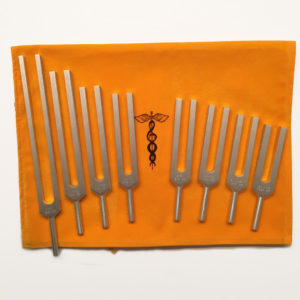
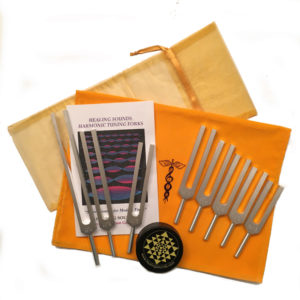
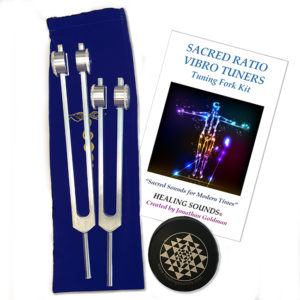
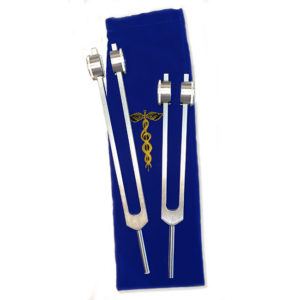
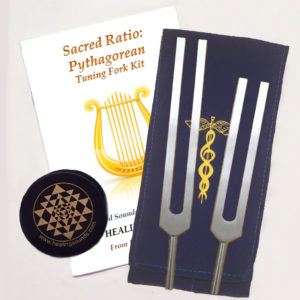
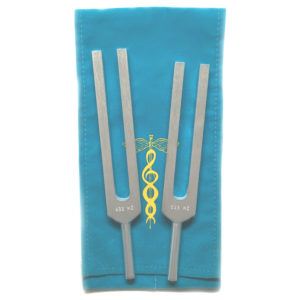
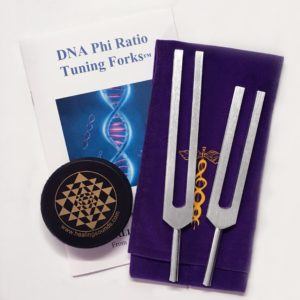
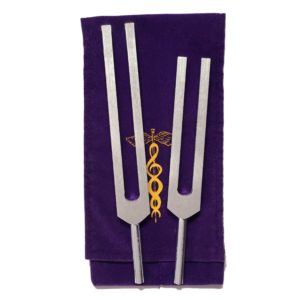
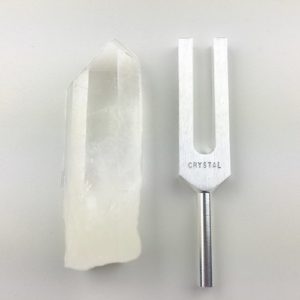
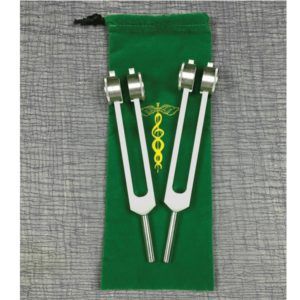
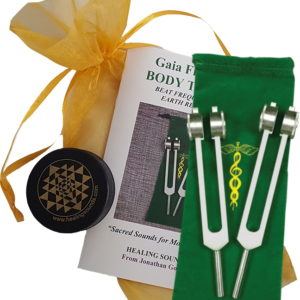
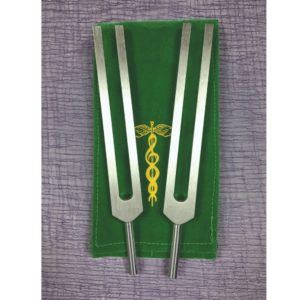
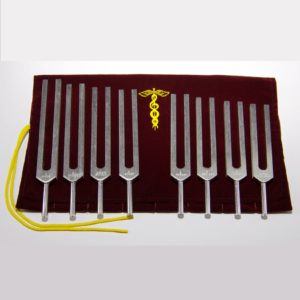
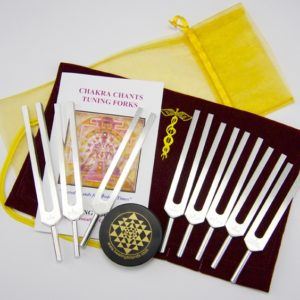
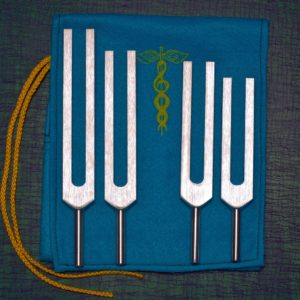
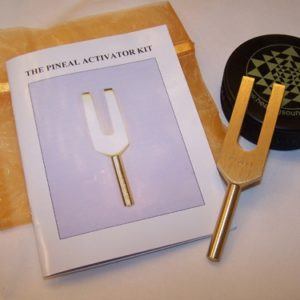
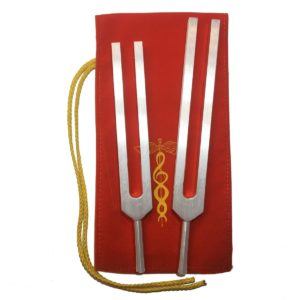
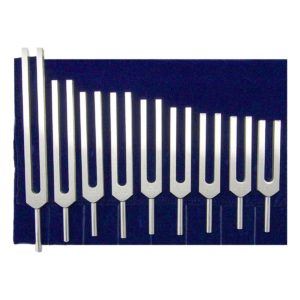
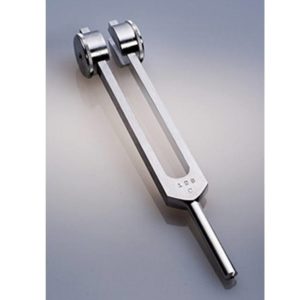
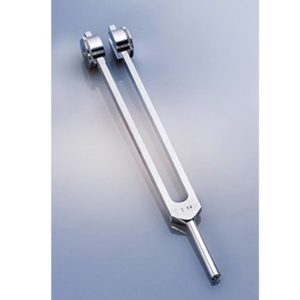
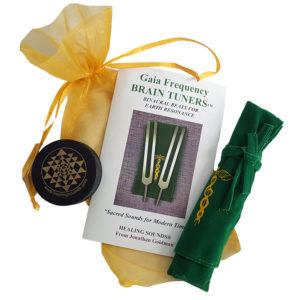
- Tuning Forks: in which a client
will receive the frequencies from specially designed tuning forks
for relaxation and balance.
- Vibro-Acoustic beds, chairs, etc.:
in which a client will sit or lie on a specially designed bed that
projects music into their body. Such devices include: the Somatron,
the Betar and the Genesis.
These categories are by no means inclusive
of all the various possibilities inherent in the field of Sound Healing
and are listed to give the reader some examples of the potential variation
of treatments found in the field.
Perhaps the greatest instrument of healing--one that is natural, cost
effective and does not require batteries or electrical outlets--is
the human voice. Toning is a generic term to describe the use of the
voice for release of pain and stress, and to help align imbalanced
portions of the body. Sighing, moaning, groaning and other sounds
we frequently make are all aspects of toning, as are the sounding
of different vowels. Often, a Sound Healing practitioner will make
sounds to a client they are working on. Usually, the client is lying
on a table during a session. These sounds made can be purely intuitive,
coming through the practitioner as they allow themselves to become
a conduit for sacred sound. Some practitioners claim to be able to
sense or hear trauma that is trapped in the physical body. By repeating
these sounds they are able to release the trauma. Some practitioners
work with a technique called "Overtoning" .
WHAT A TYPICAL SESSION IS LIKE
"Overtoning" is a technique
in which a Sound Healer will use their voice to scan the physical
body of their client and then project vocal harmonics (overtones)
into an imbalanced portion of the body (or etheric center) that is
found. A practitioner begins by making a siren like sound, starting
which at the bottom of the clients feet with a very low sound and
continues up the body, raising in pitch, until a very high sound is
created at the client's head. An experienced practitioner of this
technique will be able to hear changes in their tone as they do this.
The vocal timbre (or tone color created by harmonics in the voice)
actually changes when the sound reaches a place of imbalance. The
practitioner then proceeds to project this specific harmonic into
the area of the body where the imbalance was found. This may be for
a few minutes or longer. When the harmonic become less audible or
disappears and the tone becomes normalized, the sounding for that
area is complete. Frequently, a practitioner will find a number of
areas where sounding is needed. A practitioner may conclude the session
with discussion of the experience with the client.
This technique, while quite simple, utilizes a combination of listening
and sounding. The practitioner is listening for a change in their
tone which occurs as a result of their sound interfacing with the
energy field of their client. They must be extremely aware of the
subtle changes in their sound in order to do this technique most effectively.
The results of Overtoning can be quite astounding. Since sound can
rearrange molecular structure, it is quite possible for seemingly
miraculous things to occur; vertebrae align, muscles relax, chronic
pains disappear, traumas and blockages are released. Clients may report
feelings of being energized, ecstatic, light headed, or drowsy. However,
it is also possible for nothing to happen at all. As with many of
the healing arts, much of this may depend upon the relationship of
the therapist with the client and vice versa.
Techniques such as Overtoning are particularly effective when combined
with the many different bodywork modalities, from massage to chiropractic
to therapeutic touch. A skilled practitioner will be able to create
sounds which facilitate their modality and enable their bodywork to
reach new levels of effectiveness.
HISTORY
The use of sound as a healing modality
dates back to prehistoric times, when shaman chanted and drummed to
heal people. In the ancient mystery schools of Egypt, Greece, India,
Egypt and other centers of knowledge, the use of sound and music for
healing was a highly developed sacred science. Sonic vibration was
known to be the fundamental creative force in the universe.
In modern times, the Cymatic experiments of Swiss Medical Doctor Hans
Jenny demonstrated how various substances such as plastics, liquids
and sand would take on different shapes depending upon the frequencies
they were subjected to. These experiments showed that sound has the
ability to affect and change molecular structure. Since the body is
composed of over 75% water, it is therefore easy to understand how
sound can create change in the body.
Some pioneers in the field of Sound Healing created through instrumentation,
include: Peter Guy Manners, MD from England, whose Cymatic Instrument
projects specifically tabulated frequencies into the body, Alfred
A. Tomatis, MD, from France whose Electronic Ear, uses sound to treat
many learning disabilities and emotional problems and Robert Monroe
who discovered how to use sound waves to synchronize the hemispheres
of the brain and cause accelerated consciousness.
The voice has been used as an instrument of healing since the earliest
times and has continued to be used in this manner in the East. The
technique of "toning", using the voice
for healing, was first named and described in the book of the same
name by Laurel Elizabeth Keyes. "Overtoning", the technique
described in "typical session" was first named and described
in HEALING SOUNDS.
THE THEORY ABOUT HOW IT WORKS
The basic principle
of Sound Healing is that of resonance; every object is in a state
of vibration and therefore creates sound. This includes the various
parts of our body, such as our organs, muscles, bones, etc. If these
parts of our body are vibrating at their normal, healthy frequency,
we call this state "health". If a portion of our body begins
to vibrate at a frequency which is not harmonious to us, we call this
"disease". It is possible to use sound to project the correct
resonant frequency of that part of the body which is vibrating out
of harmony back into the body, causing it to return to its natural
frequency and return to a state of health. This projection of sound
can be done through electronic instrumentation or through using the
human voice.
The primary question in Sound Healing is: what are the correct resonant
frequencies of the body? The answer to this has not yet been fully
verified. Sound Healing scientists and researchers have determined
frequencies for the parts of the body, as well as for specific imbalances
of the body. They have invented instruments which project these healing
frequencies back into the body and all report success with their sounds.
Yet these frequencies are all different and do not correlate with
each other. There are many theories about this, but no one knows exactly
why.
In terms of vibrational medicine, another major questions arises:
do all people vibrate at the same frequency? The answer to this is
unknown. It may be that the frequencies of different people vary.
This could be an explanation as to why different instruments with
different frequencies all seem to have success. Different practitioners
have different methods of testing to determine the proper frequencies.
Some use kinesiology (muscle testing), others pendulums or radionics.
There is even a system of Sound Healing which uses a method of determining
missing frequencies found in the voice (by having the client speak
into a voice analyzer) which when added (via listening to a tape)
will supposedly restore the body to a state of health. All of these
methods have had some success. Whether they work for everyone is another
issue.
BENEFITS, LIMITATIONS, CONTRAINDICATIONS
Since sound can potentially rearrange
molecular structure, the possible healing applications of sound are
limitless. Stories exist of terminal or incurable diseases that have
been instantaneously healed through sound. However, while such miraculous
experiences may occur, it is also quite possible for a client to receive
no seeming benefit from the Sound Healing.
When dealing with the plethora of instrumentation and sound devices
currently available on the market, it is conceivable that a person
receiving the sound from an instrument may not resonate with a particular
frequency and could potentially have an adverse effect with sound.
While this would be rare, it is possible. The least invasive approach
to Sound Healing seems to be that of using the human voice.
EVALUATING A PRACTITIONER
Due to the recent rediscovery of Sound
Healing, anyone with a musical instrument, an electronic gadget or
the courage to project their voice at another person may call themselves
a Sound Healers. There are no licenses. There are in fact few programs
of study in which an individual can learn about the physiological
and psycho-acoustic effects of sound. It is hoped that a practitioner
will have understanding of the physical and energetic mechanisms of
the body. The best way to evaluate a practitioner is simply to experience
their work and see if it resonates with the individual. If a client
feels better after a session, that is good. If not, don't go back
for more.
RESOURCES FOR FURTHER INFORMATION
The Sound Healers Association (P.O.
Box 2240, Boulder CO 80306, 303-443-8181) offers training seminars
by Jonathan Goldman, sells a nationwide directory of sound healers
and other sound healing related books, tapes and products and prints
informational literature.
Recommended reading:
HEALING SOUNDS by Jonathan
Goldman (Element Books, 1992)
SOUNDING THE INNER LANDSCAPE (Caduceus Press, 1990)
MUSIC AND SOUND IN THE HEALING ARTS by John Beaulieu (Station
Hill, 1987)
MUSIC: PHYSICIAN FOR TIMES TO COME edited by Don Campbell (Quest,
1989)
SOUND HEALERS ASSOCIATION INTERNATIONAL DIRECTORY (SHA,
1995